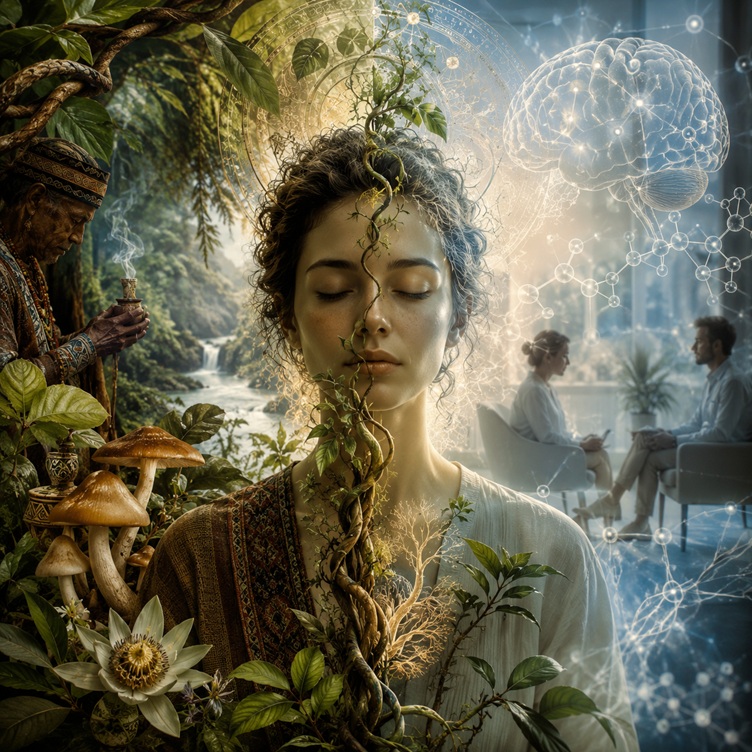
Psychedelics Are Medicine, Not Medication
Every time someone talks about psychedelics, someone else immediately appears with a look of moral panic on their face and says:
“But those are drugs.”
Yes. Of course they are.
So are alcohol, tobacco, benzodiazepines, sleeping pills, opioids, and many other substances that we have completely normalised—prescribed, sold, advertised, or consumed in ordinary homes every day.
The difference is that some drugs wear a suit, come with a prescription, and enjoy social approval, while others carry the weight of decades of fear, propaganda, and prejudice.
But if we genuinely want to talk about psychedelics, the first thing we need to do is stop throwing everything into the same category.
Ayahuasca is not ketamine.
Psilocybin is not MDMA.
LSD is not alcohol.
A carefully prepared ceremony, supported by an appropriate setting and followed by integration, is not the same as someone randomly taking substances “to have fun.”
And no, psychedelics are not sweets.
But neither are they simply “medications” in the conventional sense of the word.
They are not pills that a psychiatrist prescribes, the patient takes home, and then everyone waits to see what happens.
Psychedelics are medicine.
And that means something much bigger.
It means context.
It means preparation.
It means set and setting.
It means the body.
It means personal history.
It means symbolism.
It means spirituality.
It means integration.
It means recognising that sometimes it is not only the molecule that heals, but the entire field that opens around it.
Before We Talk About “Drugs,” Let’s Be Clear About What We Are Talking About
In simple terms, these substances can be divided into two broad groups.
First, there are the classic psychedelics: substances such as psilocybin, LSD, DMT, 5-MeO-DMT, and mescaline. They act primarily on the serotonergic system and can produce profound changes in perception, emotion, the sense of self, and consciousness.
Ayahuasca also belongs in this area because of its DMT content.
Then there are the so-called non-classic psychedelics, or substances associated with the psychedelic field: MDMA, which is more accurately described as an empathogen-entactogen, and ketamine, a dissociative anaesthetic with a well-established clinical use and growing interest in mental healthcare.
Ibogaine occupies a more complex territory. It does not fit neatly into the classic serotonergic category, but it can produce profound visionary experiences and has attracted considerable interest in the treatment of addiction.
In other words, we are not talking about one single thing.
We are talking about an entire universe. 🌌
And before we start wagging our fingers and passing judgement, perhaps it would help to learn how to distinguish at least some of its planets.
Visions, Not “Hallucinations”
Another word we often misuse is “hallucination.”
In clinical terms, a hallucination usually involves perceiving something without an external stimulus and experiencing it as objectively real, often without awareness that it is part of an altered state.
If someone hears the neighbour’s dog ordering them to hurt another person and genuinely believes that this is happening, we are dealing with a very different situation.
In a well-supported psychedelic experience, it is often more accurate to speak about visions.
Symbolic images.
Internal scenes.
Presences.
Memories.
Archetypes.
Living metaphors.
It is not simply a matter of “seeing things that do not exist.” It is about entering a language of the psyche that does not always communicate through words.
Sometimes the mind does not explain the trauma to you.
It shows it to you.
Sometimes it does not give you a sentence.
It gives you an image.
And if you do not know how to work with that language, of course it can look like madness.
But when it is accompanied skilfully, it can become profoundly therapeutic.
Ayahuasca: The Medicine You Do Not Take Before Going Clubbing
Ayahuasca is probably one of the medicines most misunderstood by the Western world.
It has been used for centuries, perhaps millennia, within Indigenous and Amazonian traditions. And no, it was not discovered because someone randomly mixed plants together as though they were making an experimental soup.
Ayahuasca combines, in a remarkable way, a plant containing DMT with another plant containing monoamine oxidase inhibitors, allowing the DMT to become orally active.
In plain English: one plant by itself would not produce the same effect. Neither would the other.
And this is where one of the questions that has always fascinated me appears:
In a rainforest containing thousands of plant species, how did they find precisely those two?
How did they know to combine them?
How did they know how to prepare them?
How did they know how long to boil them?
The Western answer usually involves trial and error.
The answer given by many shamans is different:
The plant taught them.
The plant spoke.
The plant revealed the recipe.
And this is where we begin to feel uncomfortable, because that explanation does not fit neatly into a laboratory protocol.
But perhaps the problem is not the plant.
Perhaps the problem is our modern arrogance.
Ayahuasca is not recreational. Nobody drinks a shot of ayahuasca before heading out to dance in a nightclub.
Ayahuasca can make you purge.
It can shatter your ego into pieces.
It can take you into your grief, your childhood, your fear, your death, your ancestors, your shadow, your body, God, the void—or all of them at once.
It is not a party.
It is work.
Spiritual, psychological, physical, and existential work. 🌿
This is also why ayahuasca tourism worries me so much. When an ancestral medicine becomes a tourist product, something sacred is turned into a commodity.
When there is no preparation, no integration, no respect for tradition—only money, marketing, and people searching for “the experience”—the medicine loses its context.
And without context, any medicine can become dangerous.
Psilocybin: The Food of the Gods
Psilocybin, found in so-called magic mushrooms, has been used by ancestral cultures in different parts of the world.
It is not a Silicon Valley invention.
It was not born on a biohacking podcast.
It did not suddenly appear because a burned-out executive discovered that microdosing might “optimise creativity.”
Mushrooms have been here far longer than we have. 🍄
And yes, many people use them recreationally. But reducing psilocybin to recreational use is absurd.
Current research is exploring its potential in depression, existential anxiety, addiction, trauma, neuroplasticity, and even cognitive decline. But we need to be very clear: many of these areas are still preliminary, and not everything that looks promising has already become an established treatment.
Physically, psilocybin is often gentler than ayahuasca. It does not usually carry the same purgative intensity, and its physical toxicity is very low compared with many legal substances that provoke far less public outrage.
But that does not mean it is psychologically “gentle.”
Psilocybin can also take you very far.
Very deep.
Somewhere extremely uncomfortable.
Somewhere extraordinarily beautiful.
Somewhere very dark.
Somewhere filled with light.
And once again, we return to the same elements: set, setting, dose, support, intention, and integration.
I once heard a criminologist say something that stayed with me: if the world’s most powerful politicians and leaders took psilocybin instead of cocaine, perhaps we would live on a very different planet.
Not because mushrooms automatically turn anyone into a saint.
But because these substances often push people towards connection, nature, empathy, humility, and one deeply uncomfortable question:
What am I doing with my life?
And sometimes another one:
What are we doing as a species?
LSD: Switzerland’s Child That the West Refused to Understand
LSD was born in Switzerland, in the Sandoz laboratories, through the work of Albert Hofmann.
I have always found this almost poetic: one of the most revolutionary molecules in the modern exploration of consciousness was born in one of the most orderly, precise, and pharmaceutical countries in the world.
Hofmann lived to the age of 102. And although many stories, myths, and exaggerations have grown around him, one thing is clear: he never spoke about LSD as merely a recreational drug.
He regarded it as a profound tool for exploring consciousness.
LSD was studied in psychotherapy for decades before politics, fear, and the culture wars pushed it into taboo.
Then came the counterculture, flower power, the anti-war movement, connection with nature, music, expanded consciousness—and also abuse, irresponsibility, and use without context.
As always, the substance does not exist in a vacuum.
LSD does not have the same kind of physical toxicity associated with many legal substances. There are no known deaths from a classic physiological overdose of pure LSD in the same sense that overdose occurs with opioids, alcohol, and other drugs.
Psychologically, however, it can be extremely powerful.
For vulnerable people—particularly those with a history of psychosis, bipolar disorder, severe mental disorganisation, or those using it without a safe context—it can be dangerous.
This does not mean that:
“Everyone should take LSD.”
No.
It means that we should stop speaking about it as though it were demonic poison while refusing to understand its history, its potency, and its possible therapeutic value.
5-MeO-DMT: The God Molecule Is Not a Toy
5-MeO-DMT, often associated with what is commonly called Bufo, can produce one of the most intense experiences imaginable.
Short.
Brutal.
Total.
For some people, profoundly transformative.
For others, terrifying.
It is sometimes described as “the God molecule.” And although that phrase may sound exaggerated, people who have undergone a deep experience with this substance often understand exactly why it is used.
We are not talking about pretty colours or patterns moving across the walls.
We are talking about the radical dissolution of the self.
Symbolic death.
Complete expansion.
An intensity that may be too much for certain bodies and certain psyches.
The risk here is not only related to the direct toxicity of the molecule, but also to what the nervous system may experience when confronted with something so extreme: fear, panic, overwhelm, physical reactions, cardiovascular vulnerability, and inadequate containment.
Once again, this is not a substance for improvisation.
And it is certainly not a sweet.
Ibogaine: The African Root That Faces Addiction Head-On
Ibogaine comes from the root of Tabernanthe iboga, traditionally used in spiritual contexts, particularly in Central Africa and within traditions such as Bwiti.
It is a complex, long-lasting, intense, and physically demanding substance.
In the West, it attracted considerable attention because of its possible effects on addiction, particularly opioid dependence. Many people have described a profound interruption of addictive patterns following an ibogaine experience.
But this is an area where extreme caution is necessary.
Ibogaine can involve significant cardiovascular risks. Serious complications and deaths have been reported, particularly in connection with arrhythmias, QT prolongation, pre-existing heart conditions, drug interactions, and the absence of appropriate medical supervision.
This does not invalidate its potential.
But it demands respect.
A great deal of respect.
Ibogaine is not a medicine to be taken anywhere, with anyone, without prior assessment and without medical monitoring.
Perhaps more than almost any other substance in this field, ibogaine illustrates the difference between:
“This may be profoundly therapeutic”
and
“This may be extremely dangerous when people do not know what they are doing.”
MDMA: Not a Classic Psychedelic, but It Can Open the Heart
MDMA is not a classic psychedelic. It is an empathogen or entactogen.
Its primary effect is not necessarily to take you into cosmic visions, but to open a very particular emotional window.
It can increase feelings of connection, trust, emotional safety, and openness. It has been studied especially in post-traumatic stress disorder because it may allow a person to approach painful memories without being completely overwhelmed by them.
To put it simply:
It does not erase the trauma.
But for several hours, it may change the person’s relationship with the trauma.
And in psychotherapy, that can be enormous. ❤️
There has also been considerable discussion about its potential use in couples therapy, precisely because of its ability to increase empathy, communication, tenderness, and emotional honesty.
But MDMA also carries risks. There is ongoing debate around neurotoxicity, dosage, frequency of use, substance purity, context, hyperthermia, dehydration, and excessive water consumption.
Then there is the enormous problem of the recreational market, where people often have no idea what they are actually taking.
Clinical MDMA-assisted therapy bears no resemblance to swallowing a pill at a party.
Again: context.
Again: preparation.
Again: integration.
Ketamine: The Most Medical, the Most Legal—and Also One of the Most Delicate
Ketamine is unusual because it has already been legally used in medicine for decades as an anaesthetic.
It did not appear yesterday.
It is not some strange invention created by alternative therapists.
It is used in hospitals.
It is well understood within anaesthesia.
Ketamine produces a dissociative state, and this is precisely why it began attracting interest in mental healthcare. It can create distance between a person and their suffering, almost like a temporary pause in the habitual circuits of depression.
Ketamine—and particularly esketamine—is now being used and studied in treatment-resistant depression and in cases involving suicidal risk.
The results are very interesting, especially because of how quickly depressive symptoms can decrease in some people.
But ketamine is also one of the substances in this field with the greatest potential for problematic use.
Ketamine can become addictive.
It can be abused.
Repeated, uncontrolled use can damage the bladder.
Without appropriate support, it can become another form of escape.
This is why it is so important to distinguish between clinical use, recreational abuse, self-medication, and ketamine-assisted psychotherapy.
They are not the same thing.
Using a high-profile case involving someone who died outside a structured therapeutic setting to discredit the entire field is intellectually dishonest.
It would be like claiming that because someone died from opioid abuse, all anaesthesia, pain medicine, and pharmacology are worthless.
No.
What we need is not fear.
We need precision.
Are They Drugs?
Yes.
But if we are going to use that word, let us use it properly.
Alcohol is a drug.
Tobacco is a drug.
Benzodiazepines are drugs.
Sleeping pills are drugs.
Opioids are drugs.
Caffeine is a drug.
The difference is that some drugs pay taxes, have powerful lobbyists, come with prescriptions, enjoy social acceptance, or are served in an attractive glass.
Others may help people move beyond addiction, depression, trauma, or unbearable grief—and yet they still carry the dismissive stigma of:
“But those are drugs.”
The irony is staggering.
Some of these substances show potential precisely in the treatment of addiction: alcohol, tobacco, opioids, cocaine, compulsive behaviours, emotional dependency, and the underlying trauma that often feeds them.
And yet we continue to say “those are drugs” as though the word itself ends the conversation.
It does not.
It only shows that we have failed to understand what the conversation is actually about.
Medicine, Not Medication
When I say that psychedelics are medicine, not medication, I am not indulging in cheap poetry.
I am drawing a distinction.
Medication is prescribed.
Medicine is held.
Medication is taken.
Medicine is journeyed through.
Medication targets a symptom.
Medicine may touch a person’s history, body, soul, biography, and sense of meaning.
Of course these substances can and should be studied within clinical settings.
Of course we need doctors, psychiatrists, psychologists, psychotherapists, researchers, protocols, ethics, and safety.
But we also need humility.
Many of these medicines existed long before our universities, ministries, regulatory agencies, and ethics committees.
They were not born from a patent.
They were not born inside a pharmaceutical company.
They were not born from a prescription.
They were born in rainforests, mountains, rituals, communities, songs, plants, mushrooms, roots, venoms, visions, and cultures that understood something we, in all our modern arrogance, sometimes seem to have forgotten:
Healing does not always mean suppressing a symptom.
Sometimes healing means remembering who you are.
Sometimes it means looking directly at what you have spent your life avoiding.
Sometimes it means crying the tears you were never able to cry.
Sometimes it means dying symbolically and returning with a completely different relationship to life.
Sometimes it means touching something spiritual without having to apologise for saying so. ✨
The Uncomfortable Bridge
For me, psychedelics are a bridge.
A bridge between clinical practice and spirituality.
Between science and ancestral wisdom.
Between psychotherapy and ritual.
Between neuroplasticity and the soul.
Between trauma and meaning.
Between the body and consciousness.
And that is precisely why they make so many people uncomfortable.
They do not fully belong to anyone.
They do not belong only to shamans.
They do not belong only to psychiatrists.
They do not belong only to psychologists.
They do not belong only to pharmaceutical companies.
They do not belong only to laboratories.
They do not belong only to spiritual seekers.
They are a meeting place.
If we strip away their entire spiritual dimension in order to force them into a cold clinical protocol, we may gain institutional respectability—but we may also lose an essential part of their power.
And if we leave them entirely in the hands of the market, spiritual tourism, and reckless improvisation, we will destroy them in another way.
The challenge is something else entirely:
To build bridges.
To train professionals.
To respect traditions.
To conduct rigorous research.
To accompany people with humanity.
To integrate these experiences deeply.
And to stop speaking from fear.
Because psychedelics are not sweets.
But neither are they the devil.
They are medicine.
And like any powerful medicine, they can heal, open, reveal, overwhelm, and cause harm when used irresponsibly.
The real question is not whether we should be afraid of them.
The question is whether we are willing to offer them the respect, training, and humility they demand.
If This Resonates With You
If, while reading this article, you feel that you are not looking for a “curious experience,” but for a deep, serious, and professionally supported process, this work may be for you.
Psychedelic-assisted therapy is not for everyone.
It is not recreation.
It is not spiritual tourism.
It is not a quick fix.
It is a process that requires preparation, honesty, courage, embodiment, integration, and a genuine willingness to look at what we normally avoid.
I work privately with people who feel that talking therapy, intellectual understanding, or years of analysis have not been enough to reach certain places: grief, trauma, fear of death, self-sabotage, disconnection, life crises, loss of meaning, or the need for profound transformation.
My approach brings together psychology, preparation, integration, direct experience, spirituality, and respect for the ancestral wisdom surrounding these medicines.
If you would like to learn: https://www.sashafodor.com/private-sessions-psychedelic/
Sasha Fodor
Controversial Psychologist and Digital Shaman

Signs from Beyond Death
You May Also Like